


Cavities begin as small areas of tooth decay. If left unchecked, the cavity will go deeper and deeper into the tooth leading to the need for more drastic treatment.
The dentist will likely suggest that they first check the tooth with x-rays to see if there is a chance of salvaging it through filling instead of root canal therapy (RCT). A dentist will also check the dental pulp in the affected tooth to see if it is normal or not.
Knowing the differences between deep filling vs root canal for cavities is key when deciding on the proper course of treatment for your cavity. The presence of a deep cavity does not automatically require you to have a root canal treatment.
Factors like the state of the pulp, your symptoms, findings from the clinical examination and dental x-rays are the main factors influencing your treatment decision.
What Is a Deep Cavity?
A cavity is formed by bacteria and acids that eventually damage the teeth. If a tooth cavity in the dentin gets closer to the pulp then it is considered to be a deep cavity.
This pulp tissue contains nerves and blood vessels. A dentist must assess whether sufficient healthy pulp tissue is present when decay approaches the pulp.
Some common signs of a deep cavity may include:
- Sensitivity to hot or cold foods and drinks.
- Toothache while eating.
- Pain when biting.
- A visible cavity or dark area on the tooth.
- Food getting trapped in the cavity.
- Increasing or persistent discomfort.
Getting a dental check-up in Patna as early as possible can help preserve more of your natural tooth and possibly avoid more complex treatment.
What Is a Deep Filling?
Deep fillings are used when the decay is very deep but the pulp can still be saved.
The cavities were removed from the tooth and filled with suitable filling materials during the treatment. The dentist may take a protective approach to preserve the pulp in order to help keep the tooth alive.
Modern treatment methods for deep cavities favor conservative removal of tooth material. The cavity can be removed completely, if necessary, in order to preserve as much tooth tissue as possible. Though, a deep filling is only carried out when necessary.
Deep decay is managed with a conservative cavities removal approach where this is appropriate to preserve pulp vitality and avoid unnecessary exposure.
A deep filling may therefore be considered when:
- The decay has not caused an irreversible pulp problem.
- Particular tooth remains suitable for restoration.
- There are symptoms or an examination finding that indicate the pulp is likely to recover.
- A dentist can seal and restore the tooth to full functionality.
Although, deep filling is not suitable for all cases of deep tooth decay.
What Is Root Canal Treatment?
This treatment is needed when the pulp at the center of a tooth has become infected or can no longer recover from injury.
The RCT treatment is performed by first gaining access to the inside of the tooth and then removing the pulp tissue. The root canal system is then thoroughly cleaned and disinfected and finally filled and sealed. A restoration (filling) or crown may then be required to restore the tooth.
Therefore, a root canal treatment in Patna may be necessary because of deep decay, cracks in the tooth, trauma to the tooth or dental infection.
Deep Filling vs Root Canal: What Is the Difference?
This comparison can be simply completed by considering the pulp of the tooth.
Deep filling: It is used to remove decay and restore a tooth while trying to keep as much of the healthy pulp as possible.
Root canal treatment: Remove infected or dead pulp tissue, clean out the root canal system and fill with special material to seal the tooth.
Deciding between deep filling vs root canal for cavities depends on more than just the size of the cavity. The dentist needs to assess the condition of the pulp in the tooth.
Can a Deep Cavity Be Treated Without RCT?
In some cases, yes.
Even if the pulp is healthy or has a disease that can be treated conservatively, deep decay can be treated to preserve the vitality of the pulp. The treatment might include selective removal of decay, pulp protection or other forms of vital pulp therapy.
This is why attempting to decide between a filling and RCT based only on pain intensity is not advisable. However, there are instances where an RCT is necessary i.e. when the pulp is infected or when the tooth has entered into a different dental condition that requires the removal of the pulp.
It’s not wise to decide between filling a tooth for dental decay and performing a root canal treatment (RCT) based on the intensity of tooth pain.
How Does a Dentist Decide Between a Filling and RCT?
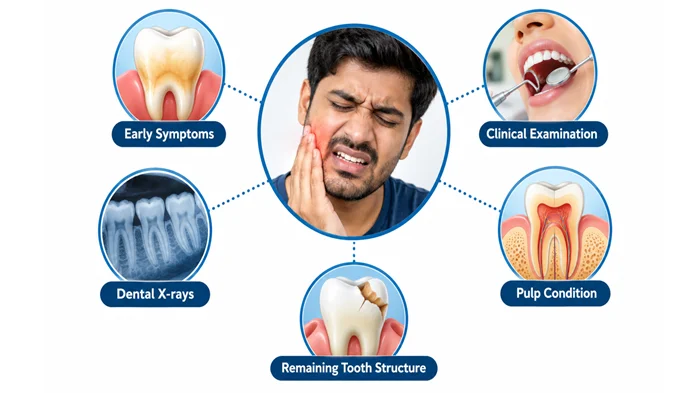
Your dentist may consider several factors, including:
- Early Symptoms: The type of pain, how long it lasts and how severe it is can give an indication as to the state of the tooth.
- Clinical Examination: The dentist will look at the tooth in question and the surrounding gums to see if there is any decay, sensitivity, swelling etc.
- Dental X-rays: Dental X-rays are used to see the extent of decay, and the surrounding structures.
- Pulp Condition: Assessing the condition of the pulp is key to any dental treatment.
- Remaining Tooth Structure: Finally, your dentist will assess whether there is sufficient sound dentine left in the tooth to allow an appropriate restoration to be made.
Considering all these factors together helps your dentist determine whether a deep filling or a root canal for a broken tooth is necessary.
Why to Choose Dr. Sachin’s Dental?
Every deep cavity may not require a root canal. Through precise diagnosis, your dentist can conserve your natural tooth and prevent performing any unnecessary treatment.
Dr. Sachin’s Dental carries out a thorough dental check-up of the patient that helps to identify the extent of decay of the tooth and also decides if a deep filling or a root canal would be the best option.
Apart from pinpointing the issue and suggesting proper treatment, Dr. Sachin’s Dental endeavours to maintain the patient’s oral health. And at the same time, the dentistry practice puts emphasis on saving the original tooth as much as possible.
Getting a proper understanding about your oral condition in the very initial stage, pain during eating or just an infected tooth in an advanced stage, can definitely enhance the effectiveness of the treatment.
Conclusion
The decision between a deep filling vs root canal for cavities depends on the extent of tooth decay and the condition of the dental pulp. A deep cavity does not automatically mean that an RCT is necessary.
However, if decay progresses further into the tooth and affects the pulp, more complex treatment may be required. Symptoms such as tooth sensitivity, pain while biting, gum swelling or visible decay should not be ignored.
Therefore, early diagnosis allows your dentist to determine whether the tooth can be restored with a filling or requires root canal treatment.
So, book your appointment at Dr. Sachin’s Dental, for expert dental care and the right treatment for your dental concerns.


