
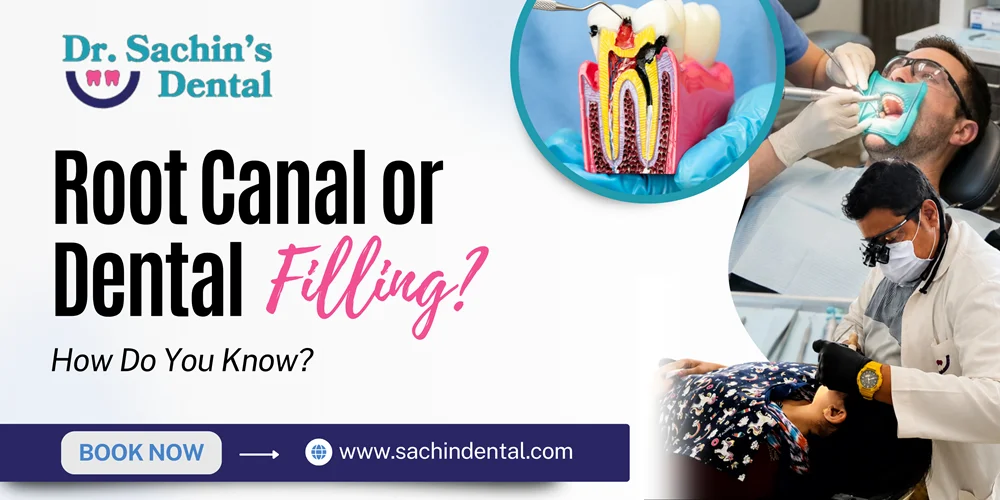

When teeth begin hurting, the very first queries which come to mind are: “will I require a filling up or perhaps a root canal treatment?”. Unfortunately, teeth ache often provides us with helpful information. However, symptoms will not tell us what therapy is necessary. As the very condition of the actual pulp, the extent of this decay, as well as the adjacent tissue should be examined.
The clinical dental examination and X-ray can indicate if it is possible to restore the tooth with a filling or if root canal treatment is necessary. Dr. Sachin’s Dental clinic in Patna provides thorough diagnosis so that the patients get suitable treatment and retain as much of their natural tooth as possible.
That’s why understanding the difference between a filling and a root canal starts with acknowledging what is happening inside the tooth, especially the condition of the pulp.
What’s Actually Being Treated: The Real Difference
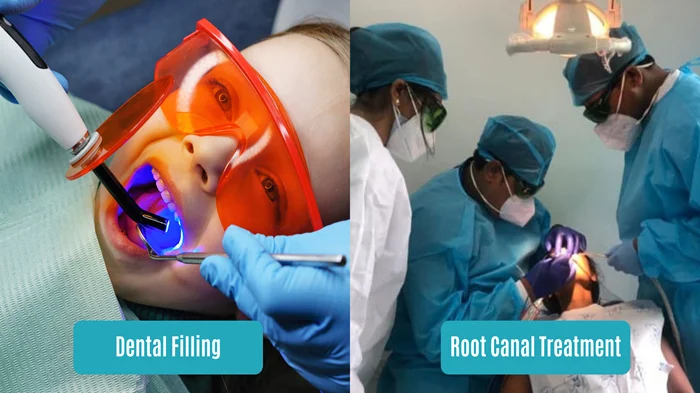
The main difference between a filling and a root canal is the state of the pulp, which is filled with nerves and blood vessels inside your tooth.
Tooth filling is a treatment for decayed or damaged teeth when pulp remains unaffected or can heal. The decayed or damaged area is cleaned and restored with a material that is compatible with your tooth. Many patients find teeth filling in Patna to be an easy procedure that involves minimal downtime.
A root canal is performed when the pulp has become irreversibly inflamed or infected. This can occur due to a deep cavity, repeated dental work, large filling(s), cracks in the tooth or even trauma to the tooth. During root canal treatment, the diseased pulp is removed, the root canals are cleaned, and the tooth is sealed.
The key question to diagnose if a tooth needs a root canal or a filling is: is the pulp of the tooth still healthy enough to recover from the problem at hand or has the problem caused too much damage to the pulp and is it irreversible?
Symptoms That Usually Point to a Filling
These signs of tooth decay need to be evaluated by a dentist even though they may indicate that no irreversible damage has been done to the pulp of the tooth.
These signs may need a filling:
- Sensitivity to cold or sweet for short periods of time and then ceasing.
- Mild or occasional tooth pain instead of persistent tooth pain.
- No significant pain when biting or chewing.
- A visible cavity without swelling around the tooth.
- Sensitivity that is short-lived and does not occur spontaneously.
- A cavity that is confined to the outer layers of the tooth.
Sensitivity like this is often associated with reversible pulpitis, but understanding the causes of teeth sensitivity can help identify the underlying issue. However, a small looking cavity can hide lots of pain. That’s why an X-ray is needed to assess the extent of the cavity before a simple filling can be carried out.
Symptoms That Usually Point to a Root Canal
Some of the symptoms are more serious for significant pulp inflammation may indicate root canal treatment.
These can include:
Lingering sensitivity
Continued sensitivity to hot and cold after 30 seconds even when stimulus is removed may indicate further inflammation of the pulp.
Spontaneous or nighttime pain
The type of pain you feel even when you are not eating or drinking anything, and wakes you up from sleep at night, indicates pulp irritation of a significant degree.
Pain while biting or chewing
Inflammation of the tissue around the root of a tooth that can cause discomfort when biting and/or releasing the bite.
Swelling or a gum bump
A dental infection might be present if there is swelling in the area of a tooth or a gum bump (pimple on the gum) that may drain pus.
Tooth discoloration
A tooth can turn grey due to a number of reasons, including decay that has affected the pulp. The dentist is able to determine whether or not the pulp has been affected by performing an X-ray to look for decay that is close to the pulp.
Deep decay
An X-ray taken in the dentist’s surgery may reveal the extent of decay and show that it is approaching the pulp. In these cases, the dentist will have to consider whether to carry out a conservative filling or root canal treatment.
Cracked tooth
A cracked tooth may cause sharp pain when biting or releasing the bite. The location and degree of the crack determine whether an rct for a broken tooth is indicated in addition to restoring the tooth.
Although, it doesn’t necessarily mean a root canal is needed but warrants further investigation with diagnostic tools.
Why Do Dentists Don’t Rely on Symptoms Alone?
Toothache pain in two different patients can be similar and yet require entirely different dental treatments. Thus, to treat a patient’s toothache, an experienced dentist cannot rely solely on the patient’s description of the pain or discomfort and decide between a filling and a root canal treatment.
At Dr. Sachin’s Dental, diagnosis may include:
- Pulp vitality testing, for example cold testing or electric pulp testing.
- Percussion testing of the teeth by tapping on them with a dental instrument to test their sensitivity.
- Palpation of the surrounding gum and tissues.
- Dental X-rays to assess tooth decay, its roots, surrounding bone & other changes.
- Visual and tactile examination of the tooth and cavity.
Together, these findings allow us to assess whether the pulp is healthy, irritated but capable of recovery or dead and non-viable.
Specializing in root canal treatments as an RCT specialist in Patna, our endodontic expert strictly follows a careful diagnosis for all patients. We also make sure to find out whether a root canal is required for a tooth or not.
What Happens If You Ignore the Signs?
Ignoring persistent tooth pain does not necessarily allow the problem to resolve. Untreated pulp inflammation can progress to irreversible pulpitis, followed by pulp death (necrosis). In some cases, patients may also notice tooth turning dark after root canal, which should be evaluated by a dentist.
Possible complications include:
- Increasing toothache.
- Gum swelling.
- Facial swelling.
- Formation of an abscess.
- Infection-related bone damage.
- Difficulty eating or sleeping.
Waiting to treat a problem can lead to further damage making a tooth that could have been saved, far worse and even have to be extracted and have a denture made.
Why Choose Dr. Sachin’s Dental?
At Dr. Sachin’s Dental, Patna we use digital dental X-rays, pulp vitality tests and a complete dental examination to determine whether you need a root canal or filling.
Tooth filling is provided using tooth-colored filling material, suitable for filling cavities, to restore the tooth of an individual in the best possible manner to render function as well as aesthetics.
However, for patients looking for root canal treatment in Patna, our approach includes the use of modern endodontic techniques like rotary instrumentation to ensure that root canal treatment is completed efficiently in a minimum number of visits. The treatment may require only one visit or two visits to our clinic in Patna.
Additionally, a treatment plan for each tooth is designed keeping in mind the individual tooth’s condition.
Conclusion
Determining whether you need a filling or root canal treatment is not just based on the amount of pain your tooth is causing. Pain pattern, clinical examination, pulp vitality testing and dental X-rays all play a part in diagnosing the tooth correctly.
Don’t wait for your toothache to turn into a mess of intense pain. Schedule an appointment with Dr. Sachin’s Dental in Patna for a precise dental assessment and the right course of treatment for your tooth pain.
Whether you need a filling or a root canal treatment in Patna, it is crucial to diagnose the dental problem at an early stage to save your natural tooth and to avoid any further complications.
FAQ’s
Here are answers to some common questions regarding healing factor, sensitivity, and what to eat after root canal treatment.
What are the first signs I need a root canal?
Persistent tooth pain, lingering hot or cold sensitivity, or pain while biting may indicate the need for a root canal. Swelling or deep decay can also be signs that root canal treatment may be necessary.
When is it too late to avoid a root canal?
A root canal may become necessary when the pulp is irreversibly inflamed or infected and cannot heal on its own.
Can a tooth heal itself without a root canal?
A tooth may heal without a root canal if the pulp is only mildly irritated. Treating the underlying cause can help the tooth recover.
Does all sensitivity mean I need a root canal?
No, sensitivity can have several causes and does not always mean the tooth needs a root canal.
What should we eat after root canal treatment?
Choose soft foods such as yogurt, eggs, mashed vegetables, and soft rice. Avoid very hard or sticky foods until the tooth is fully restored.


